
Kick Scooter as Micromobility: An Experiment
For the past few years I have been looking for a good personal mobility option that fits in the space between walking and cycling. I wanted something that was faster than walking, but that occupies less space and is easier to store than a bicycle.
Sometimes I want to move slower than I do on a bike so I can better absorb my surroundings, but I don't have the time to walk.
Sometimes I want to take the bus, but it is too full to bring a bike on.
Sometimes I want more exercise than I can get on a bike.
Sometimes I don't want to worry about where I might be able to park my bike, or I don't want to spend the mental energy to keep tabs on it.
And sometimes I want to be able to walk somewhere with somebody in one direction, but then travel faster in the other direction (walking a bike on a 4-foot sidewalk next to someone you’re trying to talk to is kind of awkward).
This is the gap in personal transportation I've been trying to fill.
Attempt Number One: Inline Skates
Two summers ago, after being inspired by the article Stan Morris wrote about Kate Fowler in March 2024, I decided to try rollerblades/inline skates. Desiring efficiency and the ability to roll over rough pavement, I bought a pair of Rollerblade Lightning 110 inline skates.
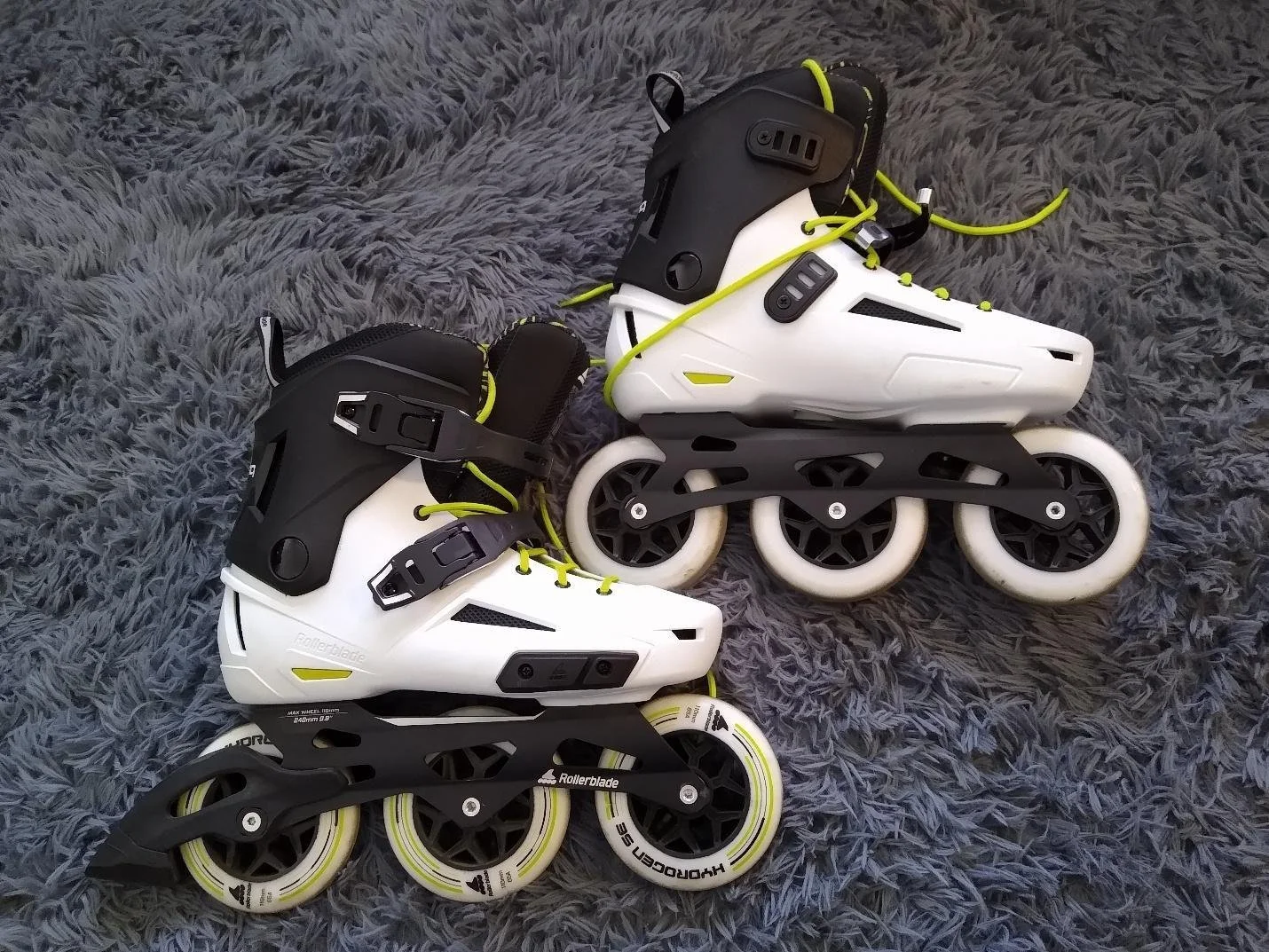
Rollerblade Lightning 110 inline skates—My first (attempted) solution
They were fast and efficient all right, but pretty quickly I discovered that my speed on the streets was being limited more by the lack of maneuverability and ability to stop than it was by any rolling inefficiencies. Going down hills was thrilling, and not in a good way. The multi-modal aspect of skates wasn’t great either, as it took considerable time to don and doff the skates, elbow pads, knee pads, wrist pads, and helmet; and the whole package was bulky and awkward to carry while not wearing it.
Attempt Number Two: Kick Scooter
Fast forward to this morning when I received a package from UPS. I don't remember where the inspiration came from, but a month or so ago I decided that I wanted to try getting around on a kick (non-electric) scooter. I did my regular internet research and concluded that the Micro Flex 200 scooter would have the best chance of success at filling this gap in my personal transportation. It has a flexible deck (like a skateboard does) to help absorb bumps and vibrations without the added weight, complexity, or drag of spring suspension or pneumatic tires. Quality appeared to be good, and replacement components available.
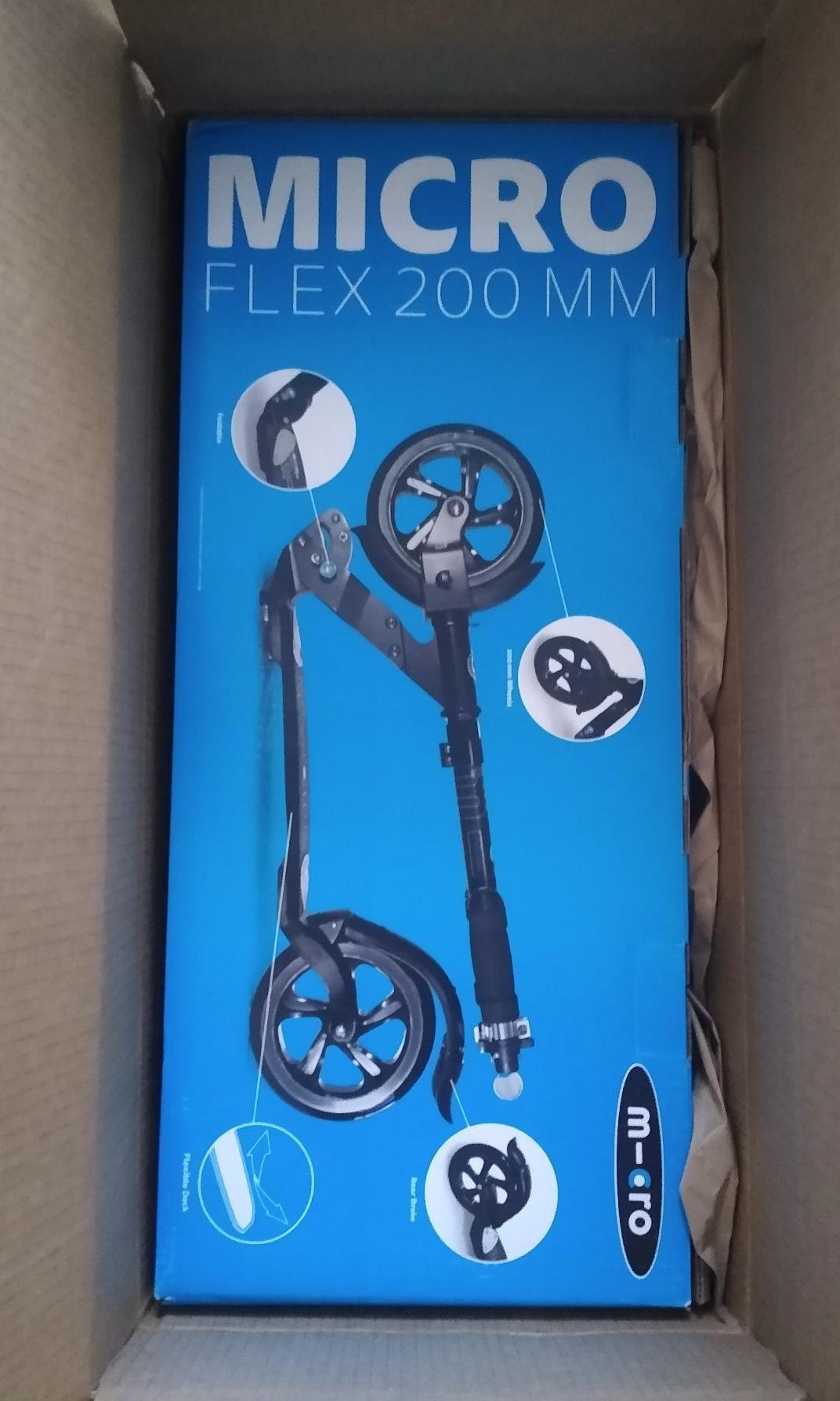
Package day!
Unfortunately, nobody sells that model in the United States. But after some determined internet sleuthing, I found a few in stock at a toy store in Ottawa that would ship to the states. I ordered one, glad to find that the price tag was in Canadian dollars. I wasn't too concerned about importing, since I've ordered bike parts from Canada and Europe before. Well, it turns out that there is no longer a minimum package value to which import duties are applied, and I was not happy when UPS told me what import fees I owed. Not like I could do anything about it at that point, though.
Anyways, the scooter arrived and I was able to do some initial testing. I hadn’t been on a scooter since about 5th grade, but it didn't take me very long to get used to the handling and to get a feel for its abilities and limitations. Here are my initial thoughts:
It's pretty amazing. Seems to be high quality and fit well in the gap between biking and walking.
It definitely isn’t as efficient as a bike for traveling longer distances, but the advantages come at the beginning and end of the journey. It’s super easy to transition between modes, and it's pretty easy to fold up and carry. I folded and took it into Making Space Thrift, and it was hardly noticeable there (compare to my bike which I have to wheel in because there's no bike parking, and it's annoyingly in the way no matter where I put it).
Seems to require the amount of physical exertion I was going for. Not as intense as running, but a lot more active than pedaling.
I like the feel of the deck flexing when I go through a dip or lift the front wheel to roll over obstacles.
It's easier to use on the sidewalk than on most of the asphalt streets in Joaquin (they're not very smooth). The periodic bumps from the sidewalk cracks are not as taxing as the constant vibration that comes when riding on the asphalt.
Unlike on a bike, the riding position is standing straight upright. If not watching the ground for obstacles, this makes it easier to see surroundings and to enjoy looking at things like the trees. More enjoying the moment than just passing through.
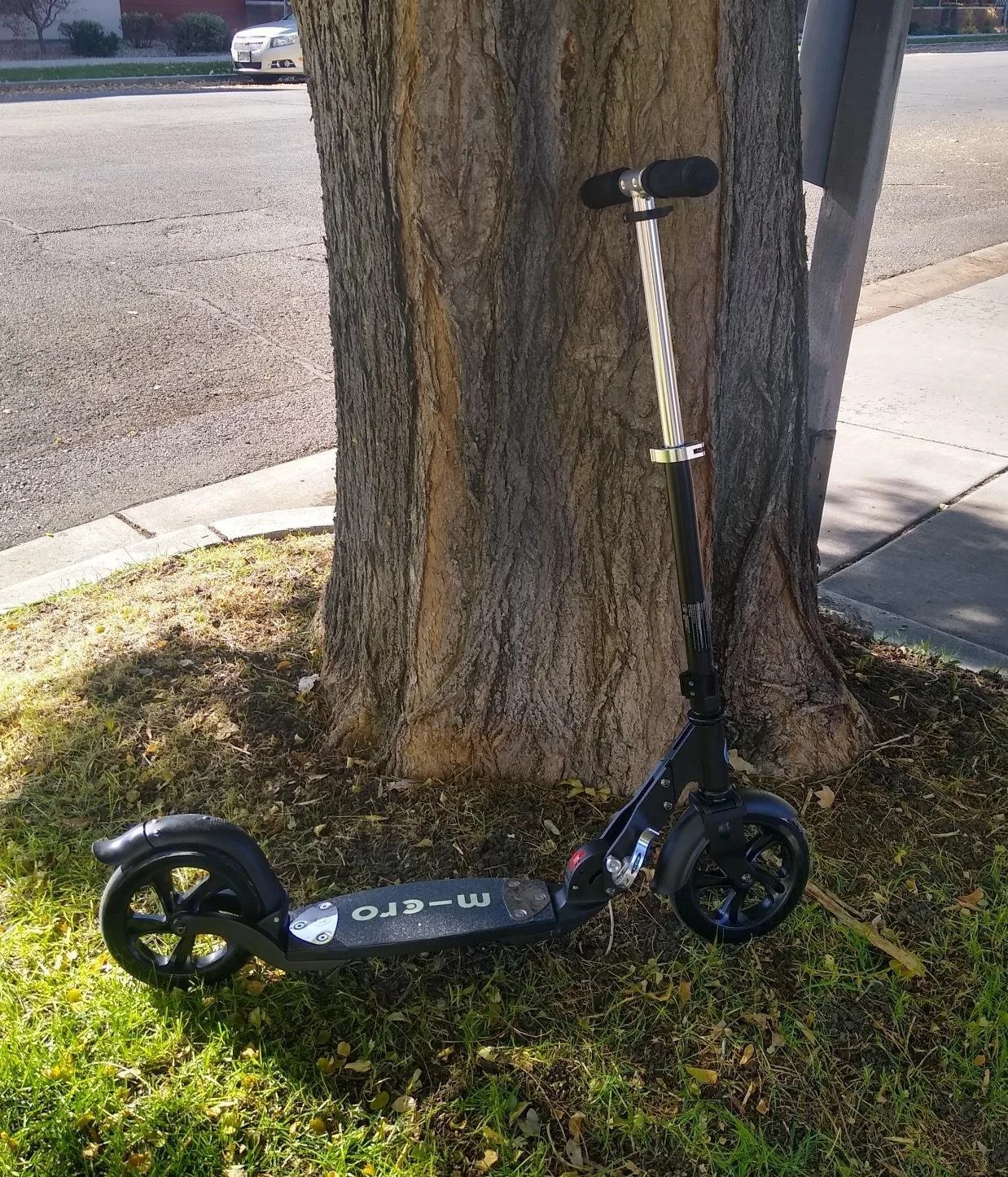
Micro Flex 200 MM kick scooter
I like it. Seems to do the job I got it for. Fits pretty much right in the middle between walking and cycling.
3-Day Update
I'm really loving getting around on a kick scooter. I'm getting more confident at maneuvering, and I can get places faster than I thought I'd be able to. Part of that is due to higher speeds than anticipated, and the other part is that I don't have to take time to park, lock, walk, and unlock like I do when I bike. It really is point to point transportation. And it's essentially effortless to switch between rolling and walking. I can just step off and lift my scooter over obstacles or carry it up stairs without breaking stride.
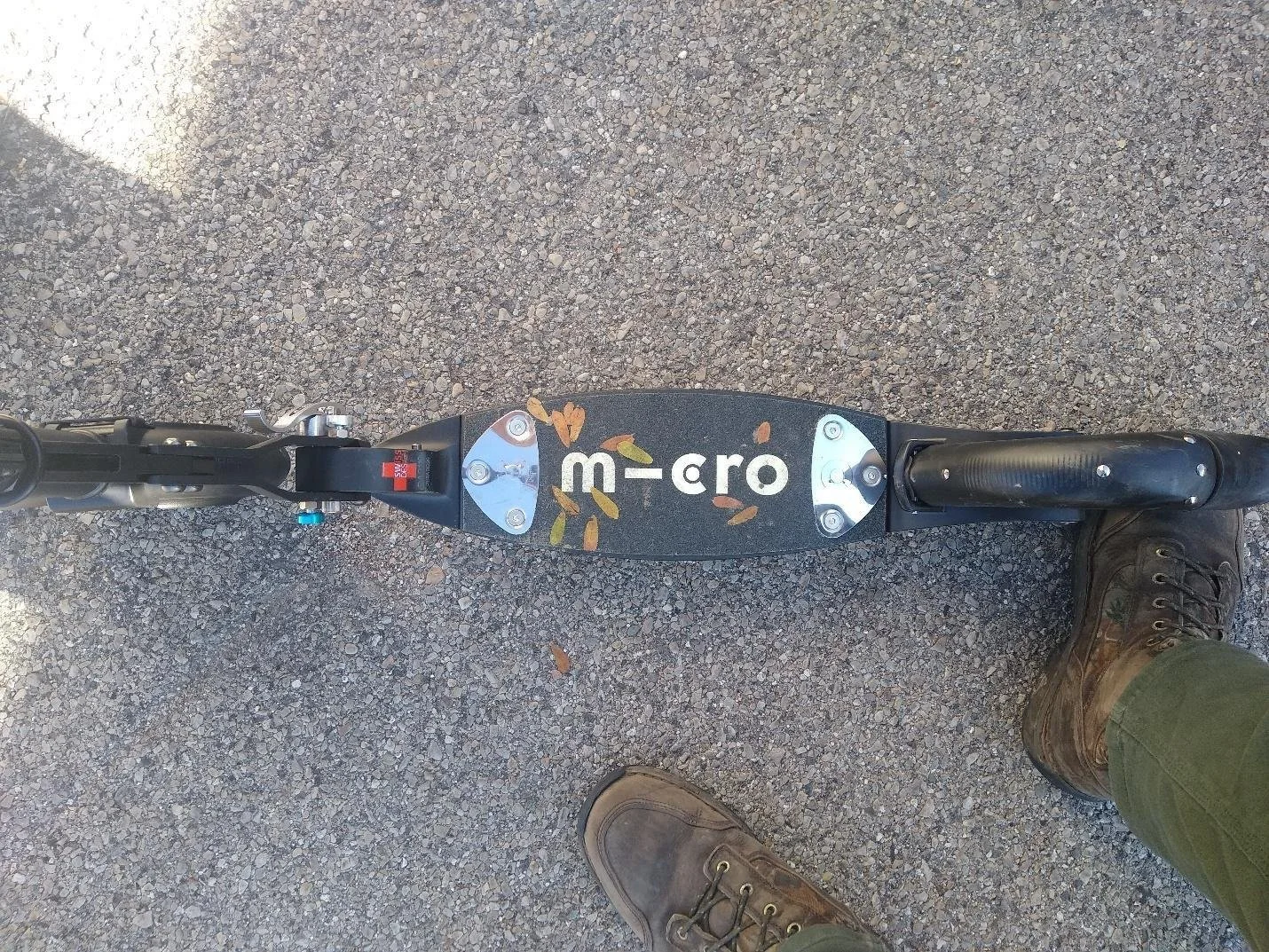
Bird’s eye view of the Micro Flex 200 MM kick scooter
Exposure and Connectedness
One thing that really strikes me about traveling by scooter is the exposure. I feel more exposed than I do on a bike. I can no longer outrun dogs, and I feel like I could be more vulnerable to people as well – both to people on foot and to drivers in cars. My footprint is not as big, I don't have the shielding that a bike can provide, and I can't get out of the way as quickly. I can't roll over every terrain; I have to be selective about my lines (mountain biking term for being intentional about where exactly on the trail you put your tires), and I can't carry very much with me. It also requires both hands to be on the grips all the time.
But I can see this exposure having positive effects. I think the most relevant one is that I feel more connected to the infrastructure. Yes, I'm more limited in the terrain I can roll on, but this helps me to notice it more. I'm much more aware of curb cuts, uneven sidewalks, rough asphalt, and hills. I'm forced to interact with people instead of just zipping by. I'm more aware of how spread out and not walkable our cities are. I feel the hostile aspects of the infrastructure personally. In essence, I am more connected to the fabric of the city. I'm part of it, and it intimately affects me. I am less insulated from everything than I am on a bike.
With the exposure, however, comes more freedom of movement. It is so much easier for me to duck into a store on a whim when I don't have to look for parking and take the time to lock up. I am not tethered to a large piece of equipment, as I can easily and comfortably carry my folded scooter wherever I need. At eleven and a half pounds and with a comfortable balance where I hold it, it’s pretty easy to manage. I don't have the feeling of being in everybody's way like I do when I bring a large bike onto a crowded bus or onto the Frontrunner at rush hour.
Because of how freely I can move around and switch between walking and rolling, the city feels more like an extension of my living room than it does when I travel by bike. I can freely go and stop without the preparation required for biking.
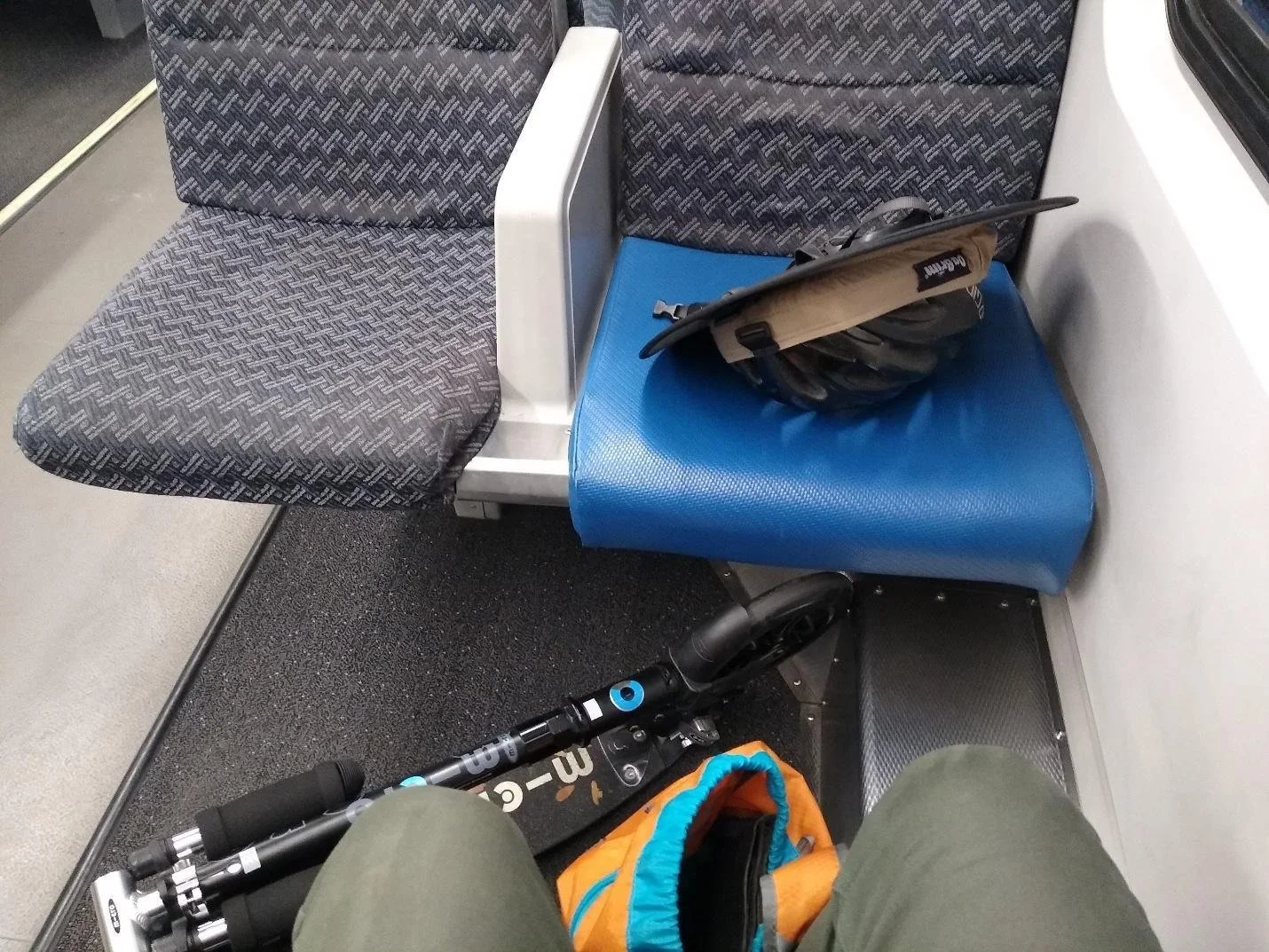
On the Frontrunner
Traveling by bike makes you more connected to the city than driving does, but traveling by kick scooter takes that one step further. A kick scooter is great for short or multimodal trips, for getting fresh air and exercise, and for casually exploring the city.
