Imagine for a moment, the icy edge of winter has subsided, the sun’s shining, it’s a calm day, and you want to ride your bike to work. You’re pedaling lawfully south down Canyon Road, not some rural winding street in the foothills but one of the main thoroughfares leading to the BYU main campus. As you near LaVell Edwards Stadium you decide you need to move out of the far right lane and onto the sidewalk, because now you’re experiencing an abnormal traffic flow, faster traffic, cars, pickup trucks and SUVs speeding, two ton vehicles exceeding the speed limit. So, you see ahead what appears to be a safe transition, a driveway, and steer your front wheel towards it, something you’ve done a hundred times, but this time the bike tire hits the raised concrete edge hard and jolts to a stop, and you go flying over the handlebars. The next moments are blurred, all you know is pain, serious pain coming from your right shoulder, pain so excruciating that you can see nothing, do nothing, but scream for help. It was March 2nd, just over a month ago when Heidi Jensen, a soft spoken mother of three, set off down Canyon Road on her commuter bike towards her office a few miles away at BYU’s Neuroscience Center.
The weather was warming, so Heidi had decided to begin commuting daily to work. “I love riding my bike,” she tells me with a smile. And isn’t this what our health, environmental, and transportation professionals have been telling us is the better alternative: using active transportation to help solve some of our more pressing issues on the Wasatch Front, and at the same time bettering our mental and bodily health. Heidi, an avid bicyclist who has been biking in Provo for eight years, “doing my miles for BYU’s [Lazy] Ironman,” was already in the habit of commuting with her children who often ride their bikes to local schools; her husband, a professor at the School of Family Life, has been bike commuting to his office at BYU for years. One of the family’s favorite outings is riding up the Provo River Parkway.
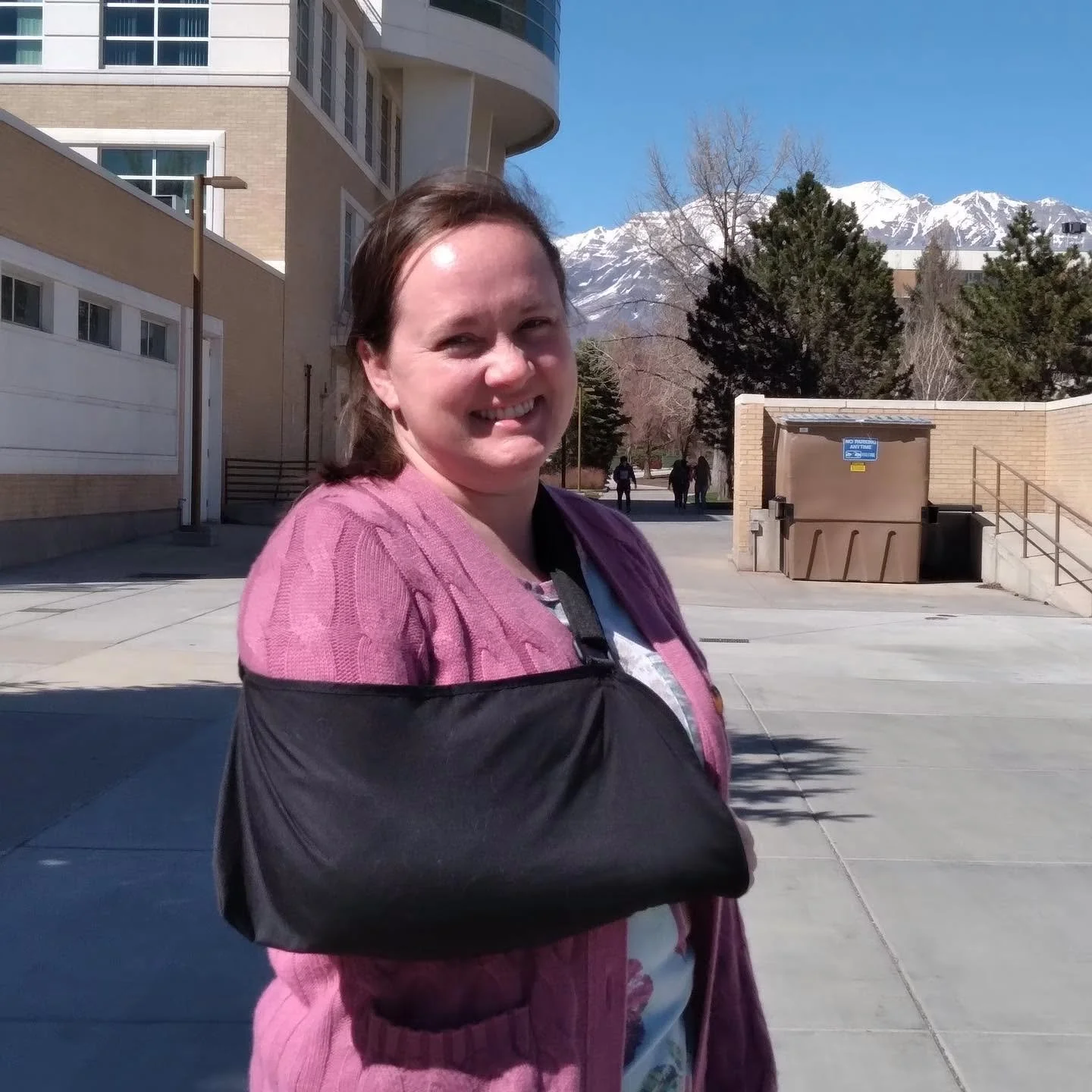
Two people nearby heard Heidi’s screams and rushed to the scene of the accident. “I felt then like I was going to be ok,” Heidi expresses with some relief but facial tension in recollecting the experience. Soon the Fire Department arrived, the care that the two Samaritans had been administering was extended by a team of professionals who, after a field examination, loaded Heidi onto a gurney and whisked her away to Utah Valley Hospital. I sit still, suspended, as she adjusts the large, black arm sling that she’s been wearing for over a month. Heidi’s humerus was broken just below the shoulder in the accident and she has to sleep in a sitting position for the duration of the healing so that it will set properly. Not accidentally, Heidi was wearing a helmet “that day,” as she always does while bicycling, so, other than some deep scrapes and scratches here and there, bodily injury was minimized.
Heidi adjusts the heavy sling once more, then articulates her hopes for more bike lanes in Provo, especially since her daughter will soon be attending Centennial Middle School and Heidi doesn’t “feel comfortable with the route.” Near the end of the interview… “I’ll be riding again,” she assured me.